








Why Specialty Pharmacy Capture Starts at Prescribing, Not Dispensing
In many health systems, nearly four in ten specialty prescriptions bypass the in-house pharmacy, despite significant investments in staff and infrastructure. This trend indicates that the specialty pharmacy capture rate does not falter at the dispensing stage. Instead, losses frequently occur upstream, where complex workflows lead to breakdowns in tasks and missed opportunities. The critical factors influencing capture rates lie in the design of connected processes and the execution of daily operations, rather than merely in statistics on abandonment or patient out-of-pocket costs. Each rescript or callback reveals a leak within the clinic and pharmacy workflow, often occurring too early to address effectively downstream.
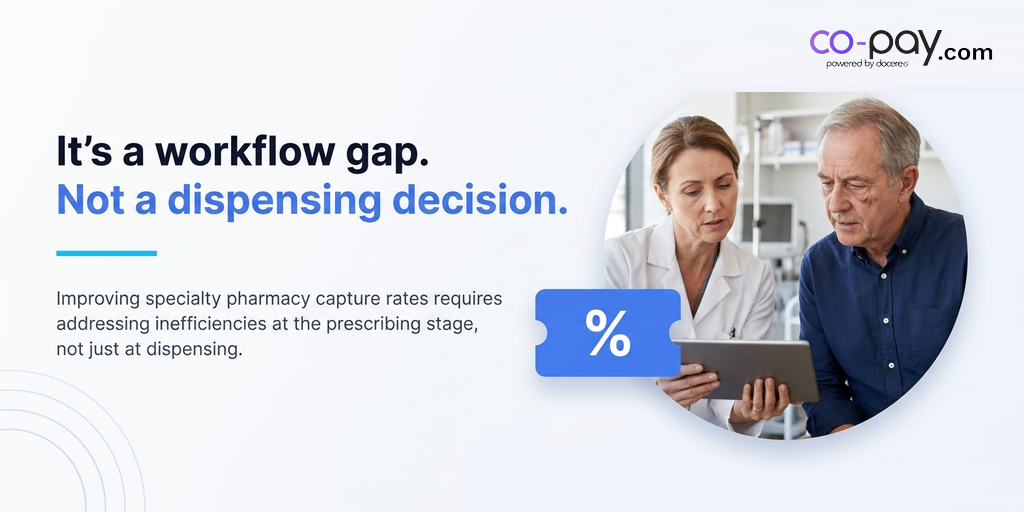
Specialty pharmacy capture is not about winning at the pharmacy counter—it is about eliminating the workflow gap at prescribing where scripts first slip through the cracks. The “activation gap” isn’t a patient decision, it is a breakdown in connected processes, often before the prescription leaves the EHR.
Specialty pharmacy capture: a problem defined by handoff risk
Capture is not a question of plugging leaks at the end of the line. Each specialty prescription is routed through at least three high-risk handoffs: prior authorization, affordability screening, and program enrollment. Every step without a connected workflow creates room for silent drop-off. The real enemy is not obvious abandonment, but the invisible reroute—a script never filled at the system pharmacy simply because the activation gap wasn’t closed early.
About 67% of patients walk away at the pharmacy counter after encountering friction, with high-cost fills exceeding $500 per prescription driving abandonment (IQVIA, 2023). For specialty, the more damaging loss often comes when a prescription is rerouted by payer requirement or benefit design, never surfacing as a captured fill inside the system. Surescripts’ 2024 specialty report makes clear: most prior authorizations for specialty therapies now begin electronically, but persistent workflow fragmentation—portal back-and-forths, rework—keeps these prescriptions from being captured reliably (Surescripts, 2024).
If the workflow does not close the activation gap at prescribing, pharmacies receive incomplete scripts, delays multiply, and available manufacturer savings remain untouched.
The typical specialty capture playbook—and the uncaptured gap
Health systems have chased capture by building major infrastructure:
- Specialty pharmacy build-outs co-located with clinics.
- Medication access teams tasked with tackling PA and enrollment.
- Hub services vendors tracking the patient journey after prescribing.
- EHR flags and routing rules intended to nudge scripts toward the system pharmacy.
Yet, national specialty fill-share through internal pharmacies remains lower than targets. Surveys show mature health systems losing 30–45% of eligible scripts to PBM-owned or payer-mandated pharmacies (AHA, 2023). The central bottleneck is upstream: much loss occurs before the pharmacy ever receives the prescription. Medication access coordinators report spending more than 15 minutes per patient on fragmented PA and enrollment tasks (MGMA, 2023).
Disconnected workflows at prescribing increase the odds of abandonment, rescript, or transfer to external pharmacies. Every repetitive call, portal login, or missed opportunity to activate affordability in the EHR opens the activation gap further.
Workflow friction: the unspoken driver of lost specialty scripts
Health system leaders often point to payer mandates as the main barrier, but much of the structural drag sits in how scripts are managed after the moment of prescribing. Workflow friction—the cumulative steps where PA, affordability activation, and enrollment are deferred or disjointed—creates silent leakage long before the pharmacy is in play.
In a specialty clinic, a prescriber enters an order in the EHR. If alerts or estimates appear, workflow can halt, but if key steps like ePA and affordability do not happen at that moment, the care team must later enter data into outside portals to start PA or seek support programs. These additional handoffs and cycles risk silent loss.
The specialty pharmacy often then receives scripts that still need PA, benefit verification, or consent. By the third call, patient and prescriber have lost patience, and the script has usually moved elsewhere. At that point, loss is operational, not just patient-driven—workflow design set the stage. The activation gap becomes real well before the patient reaches a pharmacy counter.
Where the current approaches stall
Efforts to close the capture gap generally fall into four categories:
1. Centralized medication access teams. These teams manage PA and enrollment activities. Resource-intensive, their impact varies by therapy area. Even with added staff, callbacks and rescripts consistently burden workflows (MGMA, 2023).
2. Hub vendor services. External hub vendors run PA and patient support after the script is written. They rarely integrate at the moment of prescribing, so drop-off still occurs, just handled upstream of the pharmacy (AHA, 2023).
3. Workflow flags in the EHR. Health systems try EHR nudges to direct scripts to internal pharmacies. These interventions help redirect, but unless affordability or PA is triggered during prescribing, friction continues to erode capture.
4. Specialty pharmacy follow-up. Medication access teams and pharmacists manually chase down uncaptured prescriptions via repeated calls and outreach. This downstream “rescue” effort increases staff burden and cannot scale (Surescripts, 2024).
These programs all address parts of the process, but none resolve the root problem: disconnected, friction-heavy workflows at the moment of prescribing persist as the main risk to capture.
Reframing capture: specialty success is won at prescribing, not at the pharmacy
Specialty capture is not a final-mile problem. The inflection point has moved: Surescripts’ 2024 data shows health systems that connect real-time affordability, ePA, and program enrollment directly within the EHR at the point of prescribing see both faster fills and higher in-house retention (Surescripts, 2024). Capture rate improvement no longer aligns with pharmacy counter strategies alone, but rather with workflow modernization upstream.
Teams have traditionally viewed capture as pharmacy operations or patient adherence issues, but every delayed or missed workflow trigger—ePA not launched, affordability not surfaced, consent not gathered—predicts lower capture. This is a process risk, not just a patient or payer barrier. The market’s mistake is treating capture as a downstream fight instead of an operational priority at prescribing.
For operational leaders, the lever is clear: integrate affordability, ePA, and enrollment into a single in-workflow sequence for the care team. Every “rescue” needed after the fact is an indicator that the activation gap was left open where it mattered most.
Competitor landscape: fragmented tools, unconnected outcomes
Point solutions shape today’s landscape but leave the activation gap open:
- ePA platforms (CoverMyMeds): Automate PA but generally operate after prescribing and separate from affordability or consent.
- Hub vendors (Mercalis, Relay): Orchestrate support services, but function after the prescription event and outside the EHR, with no direct impact on in-the-moment workflow gap closure.
- Coupon marketplaces (GoodRx): Offer out-of-workflow affordability, providing no attribution to the system pharmacy or real-time activation.
- Adherence engagement tools (RxAnte, Wellth): Focus on what happens after a fill, with capture already determined by earlier workflow.
No platform, aside from select EHR-native deployments, connects all pieces of the prescribing workflow to form an attribution-clear, closed-loop capture. The workflow gap persists where tools are siloed and activation remains disconnected.
What “workflow gap” closure looks like: a connected EHR-native process
Closing the activation gap demands three non-negotiables, embedded at prescribing:
- Affordability activation upfront: The EHR surfaces current benefit design, prescriber sees all available support in real time, and scripts align to the in-house specialty pharmacy.
- Inline ePA and benefit verification: Prior authorization is initiated within workflow—no handoffs, no delays, using EHR-native standards.
- Automated, consent-inclusive enrollment: Enroll in manufacturer or foundation programs instantly in the EHR, capturing consent as part of the same step. The script is tracked not by enrollment alone, but by actual fill.
Health systems who operate with this in-EHR connected model outperform those relying on counter or call-center fixes (Surescripts, 2024; AHA, 2023). Treating the "workflow gap" as the true risk makes visible what was once buried in downstream stats: specialty capture is determined when care team and patient are aligned in real time.
co-pay.com as the activation gap connector
Today's point solutions resolve bits of the workflow—ePA with CoverMyMeds, enrollment with Mercalis or Relay, affordability with GoodRx—but none close the activation gap inside the prescriber workflow. Each tool fixes part of the risk, yet no unified prescription-to-fill process exists in the system itself.
co-pay.com is designed as the workflow connection layer. Affordability discovery, ePA, AI-powered enrollment, and activation analytics run as a single, in-EHR flow linking the clinic team, specialty pharmacy, and analytics for executive visibility. The shift is not a new portal or a single “feature,” but the replacement of a fractured chain with a connected activation pathway operating inside Epic and Oracle Cerner. For health systems, this means fill share retention, not expansion of workflow burden or staff. The workflow gap closes at the only place it matters: at prescribing.
The Way Forward
The real battle for specialty pharmacy capture is won or lost at the workflow layer, not the pharmacy counter. Success no longer depends on staff expansion or more aggressive downstream intervention. Health systems securing the next phase of performance are the ones making workflow the focal point, closing every activation gap at the only place it can be closed: inside the EHR, with every stakeholder present. Leaders willing to transform process at prescribing—integrating affordability, ePA, and enrollment into a single, connected workflow—are now defining what specialty capture looks like for the next decade.
Frequently asked questions
What is specialty pharmacy capture rate?
Specialty pharmacy capture rate is the percent of specialty prescriptions written within a health system that are filled through the system’s own specialty pharmacy, rather than external or PBM-owned pharmacies. Capture rate is a key operational metric for health system pharmacy leaders, reflecting both financial performance and continuity of care (AHA, 2023).
Why does specialty pharmacy capture matter for health systems?
Specialty capture drives both pharmacy revenue and patient continuity within the system. Higher capture rates allow health systems to manage therapy adherence, provide integrated patient support, and retain pharmacy revenue. Loss of capture often results in patient experience fragmentation and lower adherence rates (AHA, 2023; Surescripts, 2024).
How does the prescribing moment affect specialty pharmacy capture?
Most specialty script losses occur upstream, before the prescription reaches the pharmacy. If affordability, prior authorization, and enrollment are triggered inside the EHR at the moment of prescribing, the likelihood of capture rises significantly. When these are left for downstream management, scripts are more likely to be rerouted or abandoned (Surescripts, 2024).
What are common workflow barriers to high specialty capture?
Typical barriers include fragmented PA workflows, affordability friction at prescribing, delayed or missed manufacturer program enrollment, and handoffs between care teams and pharmacies. Each step introduces drop-off risk, leading to callbacks, rescripts, or abandoned prescriptions (MGMA, 2023).
How can health systems improve specialty pharmacy capture rate?
The highest-impact improvements are: surfacing real-time affordability at prescribing, initiating ePA inline with the script, automating program enrollment with patient consent captured in the EHR, and eliminating downstream handoffs. Integrated EHR-native platforms are proving more effective than point solutions (Surescripts, 2024).
What role do care teams play in specialty capture?
Care teams are typically responsible for initiating PA, enrolling patients in support programs, and shepherding prescriptions to the specialty pharmacy. When this work is coordinated as a single flow inside the EHR, care teams spend less time on callbacks and rescripts, improving staff experience and capture rate (MGMA, 2023).
Does insurance mandate override health system specialty capture strategy?
Payer mandates for specialty channel routing are a significant hurdle. However, even within constraints, health systems can improve capture by removing workflow friction and providing clear documentation to payers. Early PA initiation and integrated enrollment can mitigate some payer-driven loss (AHA, 2023).
How do point solutions differ from end-to-end specialty capture platforms?
Point solutions like ePA tools, hub vendors, and coupon marketplaces each address a slice of the workflow. End-to-end platforms connect affordability, PA, and enrollment as a single step in the EHR, producing higher capture rates and closed-loop attribution to the fill, rather than just the prescription written (Surescripts, 2024).
What does “closed-loop activation analytics” mean for specialty pharmacy?
Closed-loop activation analytics tie every affordability activation, PA, or enrollment to a confirmed prescription fill at the health system pharmacy, not just to an offer served or an enrollment initiated. This provides pharmacy leaders with precise capture and abandonment data needed for operational management (AHA, 2023).
How does automation impact care team workload in specialty pharmacy?
When specialty pharmacy workflows are automated within the EHR, case managers and access coordinators see a reduction in manual work for PA, enrollment, and callbacks. MGMA’s 2023 report shows that ePA and program enrollment automation can reduce FTE burden by more than 50% in pilot settings.
Leave a Comment