











What Frost & Sullivan’s 2026 Recognition Tells Us About Where Healthcare Marketing Is Going
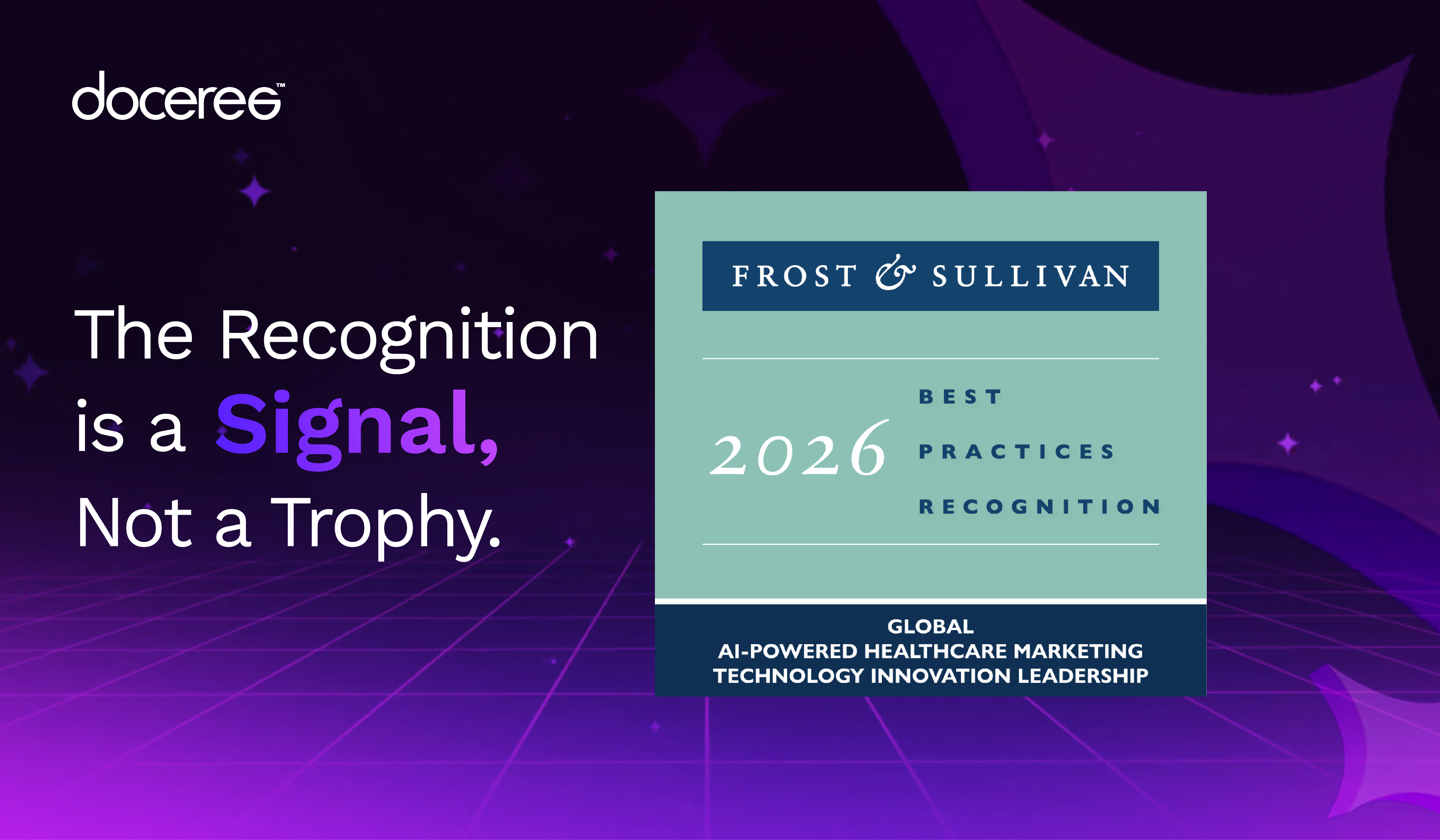
A few days ago, Frost & Sullivan named Doceree the recipient of its 2026 Global Technology Innovation Leadership Recognition in AI-powered healthcare marketing. We’re proud of it. But the more useful question isn’t why one company was recognized — it’s what the recognition says about where the entire category is heading.
Industry analysts don’t mark incremental improvement. They mark structural shifts worth paying attention to. And the shift Frost & Sullivan identified is one every pharma brand team will feel over the next two years: healthcare marketing is moving from a collection of disconnected tools toward a unified operating system — even if, today, almost no one has actually built one.
The signal beneath the recognition
For most of its digital history, healthcare marketing has been assembled rather than designed. A brand team stitched together an EHR point-of-care vendor here, a publisher network there, a programmatic platform somewhere else — each with its own data, its own metrics, its own partial view of the physician. The result was a patchwork no one fully controlled, one that left the most important questions largely unanswerable: did this engagement actually influence a prescription? Did the patient ever fill it?
Frost & Sullivan frames the moment we’re now in as the rise of an “Agentic Economy” — a transition away from fragmented point solutions toward unified platforms powered by autonomous AI. In their analysis, the recognition wasn’t about a single clever feature. It was about the emergence of an architecture: an operating system that connects the full prescription journey, from physician awareness through point-of-care engagement to adherence and fill, on one platform.
That’s the signal. The category is beginning to organize around systems, not tools.
Why this shift is happening now
Three forces have converged to make the operating-system model not just possible, but necessary.
First, fragmentation has hit its ceiling. For years, adding another point solution promised incremental reach. But each new vendor also added another data silo, another login, another partial picture. Brand teams have reached the point where the next tool adds more complexity than value — where stitching everything together costs more than any single solution is worth.
Second, AI has matured from a feature into an orchestration layer. Earlier “AI” in marketing meant slightly smarter targeting. What’s changed is that AI can now coordinate across an entire journey — reading clinical and behavioral context, activating the right engagement at the right moment, and measuring outcomes in a closed loop. That capability is what makes a true operating system possible. Without it, you have a dashboard, not a system.
Third, privacy constraints have forced a smarter architecture. HIPAA and GDPR don’t just limit what marketers can do — they reward platforms built on physician-level context and structured clinical signals rather than patient-identifiable data. The companies that designed for compliance from the start can scale precisely because they didn’t take shortcuts. Privacy-first has quietly become performance-first.
What it means for pharma brand teams over the next 24 months
If the category is moving toward operating systems, the next two years won’t be about every vendor suddenly becoming one. They’ll be about brand teams recognizing the gap — and discovering how few platforms can actually close it.
Here’s the distinction that will define the period: an operating system isn’t a feature you add. It’s an architecture you commit to from the beginning. A point solution can integrate with others, but integration is not the same as a system designed as one — with shared data, unified measurement, and AI orchestration built into the foundation rather than layered on afterward. That difference is easy to gloss over in a sales deck and impossible to fake in production.
So expect what brand teams demand to change — and a widening gap between what they ask for and what most of the market can deliver.
They’ll expect the vendor stack to consolidate. But consolidation rewards the platforms architected to unify in the first place, not the ones retrofitting connections between tools that were never designed to talk to each other.
They’ll stop accepting the vanity metric. Impressions and clicks have never captured the clinical context in which physicians make prescribing decisions. Brand teams will increasingly ask for clinical-intent-based targeting and measurement — which depends on a signal infrastructure that takes years to build and can’t be assembled from third-party data alone.
They’ll expect AI inside the workflow, not beside it — embedded orchestration across the journey, not another tool to log into. But orchestration presupposes a system to orchestrate. Without one, “AI” is just a smarter dashboard.
And they’ll expect the full prescription journey to be measurable. The break between “we ran a campaign” and “the patient filled the prescription” has been the industry’s most expensive blind spot. Closing that loop requires connecting data from awareness to fill — something a genuine operating system can do, and something no amount of point-solution integration replicates.
The recognition isn’t the story. The shift is.
We’re honored by Frost & Sullivan’s recognition, but we read it less as a verdict on Doceree and more as a marker of where the industry is going. The demand for operating systems is about to become universal. The ability to deliver one will not.
That’s the real signal beneath the recognition: not that everyone will build what we’ve built, but that the market is finally moving toward what we set out to create years ago — a system that sees the whole journey. The brand teams that pull ahead over the next 24 months will be the ones working from a system that actually exists. We built Doceree to be that system.
Leave a Comment