











The Specialty Patient You Lost in the Funnel: A Walk-Through for Brand Teams
In the specialty pharmaceutical landscape, patient drop-off during therapy access is increasingly common, driven not by clinical need or insufficient copay support but by systemic inefficiencies: an average of 35 minutes spent on prior authorizations, the juggling of seven or more payer portals weekly, and misaligned forms (MGMA, 2025; MGMA, 2026). What may appear as a patient “activation” event on dashboards often represents a stalled journey obscured by fragmented systems. The disconnect between access programs and actual therapy starts is quantifiable, revealing that drop-off is a design feature of the current specialty brand experience rather than a result of user error.
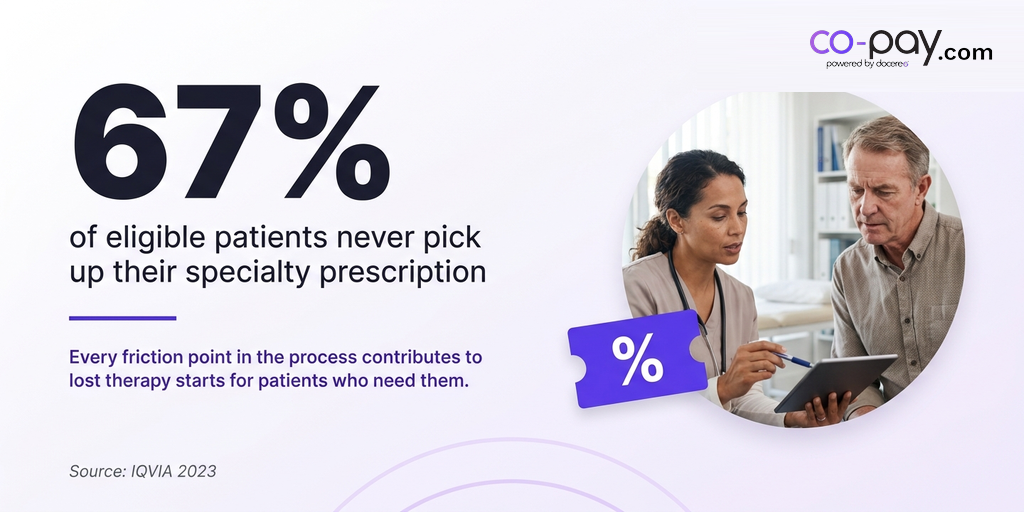
A typical specialty patient journey features three main drop-off points between prescription and therapy start: (1) savings discovery that fails before the prescription leaves the EHR, (2) enrollment friction with multiple forms, portals, or consent hurdles, and (3) prior authorization still pending when the patient arrives at the pharmacy. ePA automates just 34% of approvals, so staff may still spend upwards of 35 minutes on manual cases (MGMA, 2025; Surescripts, 2025). Nearly two-thirds of practices juggle 7 or more payer portals every week (MGMA, 2026). As a result, the specialty patient journey gap is systemic. 67% of eligible patients never pick up their specialty prescription (IQVIA, 2023). For manufacturers, the core challenge sits at the intersection of activation and workflow gaps, not patient motivation or benefit design.
How a Specialty Prescription Turns Into a Missed Therapy Start
Imagine a patient named Donte, newly diagnosed with a moderate-to-severe autoimmune condition. His specialist prescribes a high-cost, specialty biologic—precisely the scenario for which brand and access teams build their journey maps: motivated provider, branded script, copay support available. Yet, Donte’s path displays the exact breakpoints where specialty patients are most often lost.
Step 1: Prescribing Moment—The Make-or-Break for Copay Discovery
At Donte’s appointment, the clinician closes the visit by sending the prescription from the EHR. If copay or manufacturer support is surfaced natively in the workflow—triggered by the drug, payer, and patient context—Donte is set up for therapy access. But if support is buried in a static list or legacy “copay card” tools, discovery depends on staff memory or patient luck. Amid seven-plus payer portals and weekly administrative churn, time-sensitive savings are often missed at the outset (MGMA, 2026).
Step 2: Enrollment Friction—Where the Majority Fall Out
If the specialist does find the right copay offering and begins enrollment from the EHR, Donte and his care team still face multiple, fragmented steps: authentication, data re-entry, form submissions, and consent capture that may duplicate information just entered or require a print-sign-scan loop. Each added portal, PDF, or follow-up instantaneously increases drop-off risk. Over 60% of eligible patients abandon at this stage, sometimes without realizing their enrollment didn’t stick (industry estimate, 2024).
Step 3: PA-Pending—The Hidden Block Even for “Activated” Patients
Even when Donte makes it through enrollment, prior authorization can stall therapy access. Only about a third of approvals are fully automated; high-acuity drugs like Donte’s most often require manual submission, secondary documentation, or a portal detour (Surescripts, 2025). Practice staff may spend 35 minutes or more per request, with new documentation or resubmissions triggering further delays (MGMA, 2025). Neither Donte nor his brand’s dashboard sees this bottleneck in real time.
Step 4: At the Pharmacy—Most Never Arrive
When Donte arrives at the pharmacy, any remaining gap—a missing PA, incomplete enrollment, or wrong OOP expectation—can halt therapy immediately. Pharmacies sometimes try to offer workarounds, but the majority of patients in this predicament (67%) simply never fill (IQVIA, 2023). In manufacturer analytics, Donte is counted as “activated,” but not as a therapy start.
Patterns in the Specialty Patient Journey Gap
Donte’s journey amplifies the issue faced by thousands of specialty patients each month. Therapy failure at the workflow level, not just at final cost, is the rule. Instead of spotlighting every dropout in separate sections, the persistent pattern is threefold:
- Savings never discovered inside the EHR: If support is missing at prescribing, the journey ends before it starts.
- Enrollment friction creates silent attrition: Multi-step, duplicate, or manual forms yield 60%+ loss between eligible and enrolled.
- PA gets stuck off the radar: Only a third of approvals are fully automated; the rest fall into time-consuming, high-effort lanes.
Each breakpoint multiplies with every payer portal or team handoff. Fragmented workflows and redundant effort trap patients in repeating cycles of incomplete access, fueling the ongoing activation gap.
The Standard Approaches and Their Blind Spots
Manufacturer patient-support initiatives typically focus on one touchpoint and treat each bottleneck independently:
- Copay card visibility relies on static printouts or consumer-facing websites, missing the critical EHR prescribing window.
- Hub-based enrollment happens outside the EHR, so friction from authentication and consent occurs “off-path” and is poorly tracked.
- PA automation helps a subset of patients, but specialty therapies lag in real-time, connected approvals.
Analytics teams then struggle to link partial data from separate program vendors, missing where real loss happens. Efforts to optimize each point in isolation have failed to close the journey gap.
What No Dashboard Shows: Activation Is Not a Therapy Start
Measures like “activations” and “enrollments” mask the reality that most program activity ends before therapy begins. Operational failures such as data errors, incomplete PAs, or late discovery don’t register as clear failures—they persist as silent, compounded drop-offs. The workflow blind spot hides the therapy-start metric brands need for commercial improvement.
Why the Gaps Persist: The Limits of Fragmented Platforms
Bold reframe: The specialty activation gap sits at the intersection of three workflow breakpoints: discovery, enrollment friction, and PA-pending. Fragmented platforms have become the default, but they are the scaffolding for drop-off—not simply a byproduct of complexity. Closing the activation gap requires more than closing a portal; it demands a workflow that is architected for connection, attribution, and measurable completion in real time.
Fragmentation is the enabling condition for both visible and invisible drop-off:
- Co-pay discovery too often relies on staff or patient initiative.
- RTBC at prescribing is missing or incomplete for most specialty brands.
- ePA before the pharmacy excludes the most labor-intensive therapies from seamless approval.
- AI-guided enrollment remains mostly conceptual—portals and PDFs still dominate.
- Activation confirmation is lagging or incomplete.
- Patient-level analytics can only reconstruct the journey after-the-fact, never in real time.
The cumulative effect: drop-off multiplies, workflow gaps persist, and brands continue to undercount therapy opportunities.
The Reframe: One Connected Workflow Inside the EHR
Specialty activation and workflow gaps persist not because of patient motivation or benefit design but from fragmented, multi-step handoffs at the same three breakpoints. The real shift is organizational and technical: embedding every step inside a single EHR-native workflow, so all activation and workflow gaps are resolved before the patient leaves the visit.
When savings discovery, RTBC, ePA, and enrollment function as a single, continuous workflow, drop-off at each breakpoint shrinks. Enrollments land in real time, PA is triggered automatically, and the full journey becomes visible to both brand and pharmacy teams. Activation is not just an activity marker, but an actual precondition for therapy start.
What a Good Solution Looks Like for Specialty Brands
For manufacturers, the standard for fixing the journey gap is a platform delivering all six connected capabilities:
- Co-pay discovery embedded directly in the EHR by drug-payer-patient context.
- RTBC at prescribing yields instant, accurate coverage and price.
- ePA launched before pharmacy for all patients needing approval.
- AI-guided enrollment eliminates manual or portal-based forms, with full consent verification in-flow.
- Activation confirmation in real time, at the patient level.
- Patient-level analytics reporting true therapy starts and every drop-off event.
Legacy “hub plus card plus ePA” models keep fragmentation entrenched and losses persistent.
Where co-pay.com Fits
Platforms such as co-pay.com position themselves as the connective layer bridging all breakpoints. Their complete product suite:
- Surfaces copay discovery at prescribing.
- Enables RTBC and ePA fully inside EHR workflows.
- Runs AI-guided enrollment at the point of care.
- Confirms activation instantly and reports drop-off at the patient level.
The differentiator is architecture: one connected workflow, closing activation and workflow gaps, yielding therapy starts measurable in actual completions.
The Way Forward
The specialty brand landscape has long equated activation with success, but therapy starts remain flat and lost prescriptions persist. The opportunity is not optimizing isolated drop-off points, but reengineering the workflow so every activation is tied directly to measurable therapy starts. Manufacturers that invest in connected, EHR-native workflows and true patient-level attribution will see gains others miss. The shift is not about more programs—it is about closing every operational gap that keeps program outcomes from translating into therapy for real patients.
Frequently asked questions
What does a typical specialty patient journey look like?
A typical specialty patient is prescribed a complex, high-cost medication during a provider visit. Despite motivated clinicians and available support programs, the patient’s path from prescription to therapy start includes key drop-off points: missing in-EHR discovery of savings, enrollment friction (forms, portals), and prior authorization delays. Depending on how well each step is integrated, up to 67% of specialty patients never fill (IQVIA, 2023).
Why do specialty patients abandon therapy before starting?
Abandonment rates in specialty therapy are primarily driven by three process failures: lack of awareness of available savings at prescribing, burdensome enrollment requirements (forms, portals, consents), and stalled prior authorization steps. While cost is the overt trigger, operational friction at each stage accounts for the majority of losses (MGMA, 2025; Surescripts, 2025).
Where in the patient access journey does the greatest drop-off occur for specialty brands?
The biggest drop-offs occur at enrollment (roughly 60% between savings discovery and completion) and at the PA stage, where only about a third of approvals are automated (MGMA, 2025; Surescripts, 2025). If either of these steps fails, patients are lost before ever setting foot in the pharmacy.
How much staff time is devoted to prior authorization on specialty therapies?
Specialty PA cases are among the most labor-intensive. About 35% of practice leaders report spending 35 minutes or more per request, and some practices handle over 40 unique PAs per week per physician (MGMA, 2025). ePA progress is rapid, but many specialty drugs still fall outside fully automated approval, compounding manual workload.
How does payer portal fragmentation affect specialty patient access?
Medical practices report managing seven to 10 payer portals weekly (with a quarter accessing more than 11), and most cite eligibility checks and PAs as the main drivers (MGMA, 2026). This fragmentation increases administrative burden, delays patient access, and boosts drop-off risk at every enrollment and PA touchpoint.
What role does ePA play in improving specialty therapy access?
ePA has massively accelerated PA approval times, with median times for in-scope meds now at 18 seconds (Surescripts, 2025). However, specialty therapies often fall in the non-automated third, requiring extensive manual steps and multiple portal submissions. ePA adoption continues to rise but does not solve the workflow challenge alone.
What is the difference between “activation” and a true therapy start for specialty patients?
Activation refers to enrolling a patient in a savings program or support service, an event usually tracked on a brand’s dashboard. A therapy start is when the patient actually initiates the prescribed specialty medication. Many patients are “activated” but never begin therapy due to workflow failures or delays.
How can brand teams improve measurement of specialty patient journey outcomes?
Brand teams need patient-level performance analytics that track every patient from prescription through fill. This requires a connected workflow—copay discovery, RTBC, ePA, enrollment, and activation all inside the EHR—with full attribution from intervention to pharmacy fill. Only then can commercial teams see where true therapy starts are happening and where drop-off persists.
Are there solutions that close the specialty patient journey gap end-to-end?
Yes, platforms such as co-pay.com are designed to embed support within the EHR, trigger ePA before the pharmacy, and remove enrollment friction through AI-guided workflow steps. These solutions enable activation confirmation and full patient-level attribution, helping brands finally trace every copay dollar to a real therapy start.
What does this mean for patient support program investment in specialty?
The specialty funnel reveals that most unconverted program spending results from process gaps, not lack of effort or intent. Brands prioritizing connected workflows and analytics will maximize the impact of each dollar, shifting from a “support program failure narrative” to a transparent, measurable, and improvable specialty patient journey.
Leave a Comment