









The Hour Between the Clinic Exit and the Pharmacy Entrance
In many health systems, the hour following clinic closure is marked by a surge of patient voicemails and unresolved e-prescriptions. Staff members often dedicate significant time each week to navigating payer portals, addressing eligibility issues, and initiating prior authorizations (MGMA, 2026). This period highlights not a lack of patient willingness, but rather an operational choke point that contributes to post-visit prescription abandonment. Callbacks, rescripts, and staff fatigue build during this critical time, creating an abandonment cliff formed by persistent workflow gaps that must be addressed after every patient visit.
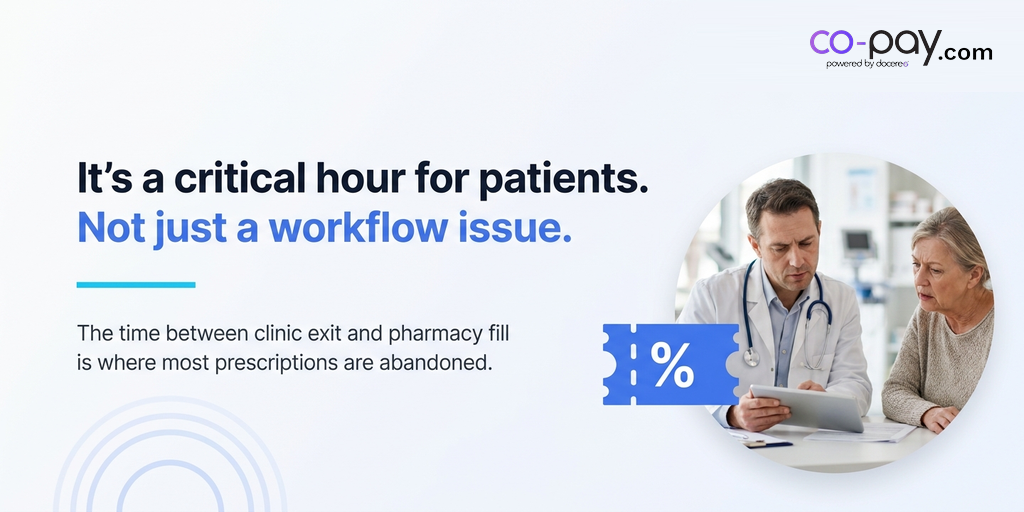
About 67% of prescriptions are abandoned at the pharmacy counter when out-of-pocket costs reach $500 or more (IQVIA, 2024), but that headline misses the crucial period the staff knows best: the window after the patient leaves, before any fill attempt. This is the post-visit abandonment cliff—the span where callbacks, rescripts, and prior authorization delays concentrate. Health systems have built downstream processes to address abandonment, but the steepest drop-off actually happens in the gap between clinic exit and pharmacy pick-up. Addressing this hour is not simply about improving patient experience. It is about workflow relief for the team enduring operational consequences.
The Hour No One Tracks: Where Workflow Burden and Patient Drop-Off Meet
Every clinical workflow carries untracked friction points for staff, and none slow operations more than the gap between visit and pharmacy fill. The majority of callbacks, rescripts, and unresolved cases surface right after the clinic visit—before the pharmacy is engaged. Each prescription triggers a web of fragmented tasks: verifying eligibility, chasing PA, and fielding confused patients who arrive at the pharmacy not knowing what to expect.
MGMA’s 2026 survey found that 61% of medical practices require their teams to access seven or more payer portals per week just to manage eligibility and prior authorization (MGMA, 2026). This fragmentation produces repetitive logins, redundant data entry, and information out-of-date by the time the patient reaches the pharmacy. Hours are lost to these tasks, keeping frontline staff from direct patient care.
The patient’s journey is rarely linear. Even well-resourced clinics wrestle with friction that keeps prescriptions from smoothly moving from EHR to pharmacy pickup. Many patients assume their medication is waiting at the pharmacy. Instead, paperwork, missing details, or PA roadblocks leave orders in limbo. For staff, every unfilled script means more phone calls, new prescriptions, and added workload pressure.
The Cliff Beneath the Data: Moving Beyond Counter Abandonment
Numbers reveal only the headline. The “67% abandonment at the counter” stat (IQVIA, 2024) overlooks the deeper mechanics. Real leakage happens upstream—a workflow gap in which prescriptions never even make it to the shelf.
NCPA research estimates a 9% Rx abandonment rate (NCPA, 2024), but this broad metric conceals when loss truly happens. Industry focus is often on point-of-sale, yet operational leaders recognize invisible volumes: scripts lost before the pharmacy ever sees a usable order.
These are rooted in recurring workflow breakdowns:
- Pending prior authorization: Delays and holds linger until long after the patient leaves.
- Eligibility misses or denials: Only caught at the pharmacy, exposing gaps in upstream action.
- Patient confusion: When instructions are unclear, patients are left stranded between care team and pharmacy.
- Affordability gaps at prescribing: Cost issues often surface too late, and the abandonment cliff is already behind the patient.
Each scenario worsens staff workload: more rescripts, more phone calls, more time lost to remediation. For health system leaders, the crux of the problem is not the abandonment rate, but the workflow architecture that pushes staff into endless catch-up.
Diagnosing the Hidden Causes: Why Post-Visit Abandonment Remains High
Fragmentation is the constant thread through post-clinic abandonment. At the staff level, the EHR, insurance portals, and pharmacy platforms rarely communicate in real time. Any missed eligibility step or unsigned PA request requires manual catch-up, compounding operational burden.
MGMA data show practices face up to 43 prior authorizations per physician each week, with processing times of at least 15 minutes each (MGMA, 2025). The effects cascade: what should be a straightforward therapy start bogs down in repeated manual follow-up.
Persistence of siloed, batch-oriented payer systems further compounds delays. Real-time technology remains underutilized, and updates lag behind clinical realities. Problems draw attention too late, triggering a cycle of retroactive fixes.
For patients, this is rarely visible but deeply consequential. Surescripts reported over 1 billion uses of Real-Time Prescription Benefit tools in 2025 (Surescripts, 2025). The gain only happens when activations, enrollments, and PA steps are finished while the patient is still present. Otherwise, every process deferred post-visit becomes another operational fire to fight.
Collectively, these incomplete connections illustrate a simple truth: the vast majority of so-called patient abandonment is a structural byproduct of steps left open after the visit and handed off to staff.
Existing Approaches: How Health Systems Try to Bridge the Gap
Common responses repeat across the industry. Most health systems address rising burdens by adding staff: medication access coordinators or pharmacy techs work the backlog of PAs and denials. Cost rises, but the fundamental process gap persists—workload is shifted, not solved.
Other clinics invest in specialty pharmacy services or partner vendors to contact patients after the visit. Phone outreach, patient apps, and reminders address only part of the issue. When eligibility or program enrollment is deferred, patient engagement sags, and abandonment remains unmitigated.
Technology interventions are everywhere. EHR-integrated PA modules or dispensing-system alerts provide visibility but rarely advance manufacturer affordability programs or complete activation steps inside the visit. Even prominent tools like Surescripts’ Real-Time Prescription Benefit, used over 1 billion times in 2025 (Surescripts, 2025), only deliver results if linked to decisive workflow action—activation, enrollment, and PA in one process.
Some centers consolidate outreach within specialty pharmacy teams, improving clearance for specific cohorts such as oncology patients. But these models rarely scale across business lines that require rapid, reliable workflow activation at the point of prescribing.
Where These Approaches Fall Short: Fragmentation and Workflow Drift
None of the prevailing solutions close the operational loop that defines the abandonment cliff. Staff are still left patching the gap by hand: making calls, processing rescripts, chasing authorizations, and working across fractured systems. The fundamental answer is not another tool or more outreach, but a connected prescribing process nested within the EHR. MGMA reports that access staff still spend too much time wrestling with disparate portals for upstream tasks that should be completed in the original order (MGMA, 2026).
Point solutions help surface requirements—such as a PA—but rarely drive the full series of activation steps right then and there. Staff pick up leftover tasks, and the workflow gap remains.
Specialty pharmacy centralization can move the burden downstream but creates new silos, unless data flows back into the EHR. Unless documentation, eligibility, consent, and activation steps auto-update within the workflow, the friction just shifts lanes.
Measurement is also a persistent gap. Many programs count notifications or outreach, but not confirmed therapy starts. Operational leaders lack closed-loop metrics tying intervention to impact—making improvements difficult to quantify.
The Gap No One Names: The First Fill Abandonment Cliff
Industry dialogue emphasizes abandonment at the pharmacy counter, but neglects the decisive breakpoint between clinic exit and first fill. The highest risk for abandonment accumulates at the first fill abandonment cliff, where fragmented workflows determine the outcome.
This gap is a structural feature. Fragmented technology and sequential hand-offs scatter key steps—co-pay discovery, enrollment, PA initiation—across unconnected portals. These could live inside a single EHR-native workflow and be completed before the patient departs, but too often remain open at visit’s end. The clearest breakpoints are (1) discovery, (2) enrollment friction (site of 60%+ drop-off), and (3) PA-pending hold-up.
Prescribing tools may show benefits or support, but rarely blend every manufacturer step and every activation into a connected flow. Downstream analytics and activation confirmations become secondary, while care teams are saddled with leftover burden. In the first hour post-visit, gaps solidify into abandonment risk.
Operational leaders see a consistent pattern: until workflow is made whole inside the EHR, burden falls on the care team, not the patient.
Post-visit prescription abandonment is not caused by patient apathy. It is the symptom of a workflow gap created by fragmented, sequential steps—where activation, enrollment, PA, and affordability are not completed as one connected process within the EHR.
The Reframe: Why "Post-Visit Prescription Abandonment" Is a Workflow Gap, Not a Patient Problem
Traditional narratives place blame on patients for not filling scripts, but evidence reveals a different cause: workflow cracks between clinic and pharmacy, especially where EHR connectivity fails. When activation, eligibility checks, and enrollments require moving between portals, abandonment is a natural result—even when coverage and affordability help exist.
MGMA's latest findings directly correlate high portal burden to staff fatigue and lower efficiency (MGMA, 2026). This is the true activation gap. The insight is clear: intervention begins with workflow, not with patient reminders.
Real relief is not about rescue after the fact. It demands embedding all necessary steps—eligibility, affordability, PA, enrollment—into the prescribing process, finished inside the EHR before the patient walks out.
Reframing abandonment as a workflow dilemma gives leaders a lever. The prescription process must be designed so the gap never opens, and operational impact is measured not by outreach, but by success in closing the gap upstream.
What Good Looks Like: The Criteria for Closing the Post-Visit Gap
Any solution that truly closes the abandonment cliff relies on three pillars:
- EHR-native workflow: All actions—co-pay discovery, eligibility check, PA initiation, AI-guided enrollment, affordability activation, activation confirmation—happen inside the prescribing system.
- End-to-end connection: No manual handoffs or piecemeal enrollment. The entire process, including patient-level analytics, is finalized before patient departure.
- Closed-loop measurement: Track operational impact through confirmed therapy starts, by site and specialty, not just by counting actions or forms.
A program only works if it decreases callbacks and cuts open tasks in staff queues. Operational outcomes—not software features—define the bar.
Where Connected Workflow Changes the Math: The Category-Level Bet
The current product landscape is shaped by fragmentation. Solutions like CoverMyMeds automate prior authorizations but separate affordability and activation as later steps. Hub vendors like Mercalis and Relay manage enrollment and support tasks, yet typically intervene only after a prescription exits the EHR. Consumer coupon tools such as GoodRx function outside the workflow, never connecting PA or activation at the care site.
co-pay.com is designed as the connective layer: integrating co-pay discovery, real-time benefit checks at prescribing, ePA before the pharmacy, AI-guided enrollment, activation confirmation, and analytics—inside the EHR itself. The wager is that closing the workflow gap up front means every step to avoid abandonment happens in one seamless process. For manufacturers, this brings the payoff: more completed enrollments, more confirmed therapy starts, and measurable ROI before the prescription reaches the pharmacy.
The Way Forward
Abandonment in the hour between clinic exit and pharmacy entrance results from the unfinished work of fragmented workflow, not from patient behavior. For specialty pharma manufacturers and healthcare operational leaders, the imperative is to shift every intervention upstream. Embedding every activation step into the prescribing workflow—and closing the activation gap at all three breakpoints: discovery, enrollment, and PA pending—translates operational effort into real therapy starts.
Looking ahead, measure progress by confirmed therapy starts, not just actions taken. Hold workflow design to the standard of eliminating post-visit staff burden. The era of downstream salvage is ending. The next advance will be defined by structural prevention, accomplished through connected EHR-native workflow that closes every gap before the patient crosses the threshold.
Frequently asked questions
What is post-visit prescription abandonment?
Post-visit prescription abandonment refers to prescriptions written in the clinic but never picked up at the pharmacy, due to incomplete activation steps after the patient leaves but before the first fill. Common causes include stalled prior authorizations, missed eligibility steps, and late discovery of cost barriers. While 67% of patients abandon high-cost prescriptions at the counter, the real drop-off often starts in the activation gap within the post-clinic, pre-pharmacy window (IQVIA, 2024).
Where does abandonment happen after a clinic visit?
Most abandonment occurs immediately following a patient’s clinic exit—before the pharmacy ever receives a complete, processable prescription. Key drivers include pending prior authorization, eligibility problems discovered at the pharmacy, and lack of real-time cost visibility at the time of prescribing. Workflow fragmentation in this window creates a high volume of callbacks and rescripts for health system staff (MGMA, 2026).
What causes patients to abandon prescriptions after the clinic?
The main causes are administrative and workflow-driven: missing or delayed prior authorizations, incomplete eligibility checks, patient confusion around next steps, and affordability gaps revealed only at the pharmacy. Fragmented systems and manual handoffs exacerbate these problems, leading to high rates of abandonment before the patient even attempts to pick up the medication (NCPA, 2024).
How can health systems reduce post-visit prescription abandonment?
By connecting eligibility, PA, enrollment, and affordability activation inside the EHR and closing the loop before the patient leaves. EHR-native workflows that automate these tasks reduce the manual burden on care teams and the abandonment risk for patients. The most effective solutions track intervention to actual therapy starts, ensuring operational improvement (Surescripts, 2025).
Why does the gap between clinic and pharmacy matter for operational leaders?
This gap translates directly into staff burden—callbacks, rescripts, lost productivity, and patient dissatisfaction. It is where manual workflow time accumulates, driving up burnout and reducing efficiency in medication access programs. Closing the gap can free resources and improve care team morale (MGMA, 2025).
How does payer portal fragmentation increase abandonment?
When care teams must navigate multiple payer portals—7 or more weekly for most practices, per MGMA—errors and omissions rise. Every additional portal increases risk for missing key steps, especially eligibility and PA completion, causing more prescriptions to stall after the visit and before the fill (MGMA, 2026).
What operational metrics should health systems track to measure improvement?
Key metrics include volume of post-visit callbacks, rescript rate, time-to-completion for PA, first fill abandonment rate, and percentage of therapy starts confirmed. Tracking these at the site or specialty level gives operational leaders actionable insight into where burden and opportunity concentrate (NCPA, 2024).
What is the role of Real-Time Prescription Benefit tools in reducing abandonment?
Real-Time Prescription Benefit tools provide prescribers with real-time information about patient coverage and medication costs, enabling them to address potential affordability or PA barriers at the moment of prescribing. Surescripts reports over 1 billion uses in 2025, indicating growing adoption and impact on adherence (Surescripts, 2025).
Are specialty pharmacy programs sufficient to address the abandonment cliff?
Specialty pharmacy programs can address abandonment for select high-touch therapies, but often rely on manual outreach and do not scale across all service lines. Without native EHR integration and closed-loop connectivity, manual burden persists and operational gains are limited (NCPA, 2024).
Why is measuring to therapy start important in evaluating interventions?
It is not enough to measure scripts written or forms completed. Only by tying interventions to confirmed therapy starts can health systems ensure real impact for both patients and operational teams. This focus enables leadership to track true operational improvement and justify investment in workflow change (Surescripts, 2025).
Leave a Comment