












The Handoff Tax: Counting What You Lose Between Vendors in Your Specialty Funnel
In the specialty pharmaceutical landscape, enrollment numbers may rise and digital outreach may broaden, yet confirmed therapy starts often lag behind. The root cause of this gap is not merely cost or coverage; it lies within the workflow, where friction and loss accumulate with each transfer of responsibility between vendors. Handoffs represent critical points where support programs can falter. What remains unmeasured at each transition adds up to significant losses: therapy starts that slip away and ROI that quietly erodes as the funnel narrows.
Brand teams searching for ways to address the “handoff tax” are really confronting the compound impact of workflow-driven loss that arises as patients move from discovery to enrollment, then through prior authorization, and finally to first fill. Each transition, often obscured by fragmented vendor processes, is a silent drain on patient support effectiveness. These breakpoints are not background noise—they are structural leaks that determine whether support programs deliver actual results.
Why every handoff is an exit: the anatomy of specialty access
No two brand funnels are the same, but the underlying workflow steps are nearly universal. A patient support journey covers multiple vendors, each responsible for a discrete segment: a hub manages enrollment, eligibility verification comes next, then prior authorization submission (often via CoverMyMeds or similar), and pharmacy activation is the endpoint. Data analytics teams try to trace the journey, piecing disparate steps together.
These stages look linear, but every transition hands responsibility off to a new vendor or system. Each handoff brings risk: a patient misses a portal invite, a benefit check stalls, or a PA that never reaches the pharmacy. Every breakpoint is a potential drop-off. What looks like simple workflow mapping is really a series of filters, with invisible loss accumulating at each seam.
This dynamic undercuts even strong top-of-funnel numbers. Market access and patient services teams see “high” enrollments and strong digital impressions, but actual therapy starts reveal a much smaller cohort getting through the gauntlet of handoffs.
The "handoff tax" is the cumulative loss of patients and program ROI as responsibility for a patient moves from one disconnected vendor system to another, typically at the discovery-to-enrollment, enrollment-to-PA, and PA-to-activation breakpoints. These workflow gaps are where drop-off is no longer a mystery: it is measurable, addressable—and increasingly, a core metric for manufacturers committed to accountable patient support.
The three breakpoints where workflow gaps trigger the most loss
Fragmentation is not a general nuisance, it is engineered into the pathway. For the manufacturer audience, specialty funnel loss concentrates at three operational choke points:
- Discovery-to-enrollment friction: Patient support programs build channels for discovery and outreach. Yet if enrollment relies on an external portal or form, many patients never cross the chasm. These are the “discovered but never enrolled”—the largest single group lost to patient support (AMA, 2025).
- Enrollment-to-prior-auth delay: After enrollment, many patients face a lag before prior authorization starts. PA details may surface late, or are kicked off by the wrong party at the wrong time. In this zone, nearly 80% of physicians report abandonment due to PA friction, while most experience delays (AMA, 2025).
- Prior auth-to-first fill (PA-pending gap): Even with an approved PA, breakdowns in handoff or pharmacy communication can prevent patients from getting their medication. Patient loss compounds at this final step, as data and process gaps remain (AMA, 2025).
Each point acts as a workflow filter. Handoffs create compound risk. Vendor-centric metrics may show local success, but those numbers rarely reflect total fallout across the full journey. For manufacturers, these are the tangible breakpoints where the handoff tax is most costly.
The data behind handoff-driven loss
Most scrutiny falls on the PA step, but viewing loss as isolated to that stage misses the real pattern: compounding filters appear at every handoff. Practices now process nearly 40 PAs per provider weekly—a volume that consumes two business days’ worth of staff time (AMA, 2025). With each handoff, the odds of patient or data loss rise. These workflow failures register as measurable gaps in program ROI.
The administrative toll is clear. U.S. hospitals spent $18 billion overturning claims denials and $43 billion collecting outstanding payments in 2025 alone (AHA, 2025). While not exclusive to specialty, the workflow complexity for these drugs escalates the challenge and sharpens the cost of every disconnected handoff.
Why handoffs lose patients: category reframe for manufacturers
Old framing blamed patient loss on vague “complexity” or “cost barriers.” The true cause is operational: each workflow handoff is a risk multiplier.
Even programs with robust discovery, digital campaigns, and call center support can lose most eligible patients at the seams between vendors. Category boundaries—hub tools, ePA platforms, analytics—trap data and stall processes where responsibility shifts. As a result, patient loss at these junctions is neither accidental nor random. It is the inevitable result of lack of direct, continuous workflow inside the EHR. Brand dashboards may show positive metrics at isolated intervals, but unmeasured loss accumulates out of view.
For specialty manufacturers, closing this measurable gap is now an accountability mandate. The handoff tax is not unexplained attrition but a systemic operational cost.
Category landscape: fragmented vendor stacks vs. workflow connection
Most major vendor offerings are siloed by function:
- Hub vendors: Enrollment and patient services via call centers or external portals, mostly outside clinical workflow.
- ePA platforms: Automated prior authorization kick-offs, but almost never connected to initial discovery or seamless with pharmacy activation.
- Benefit verification and RTBC: Surface cost and coverage to providers, but rarely reach enrollment or PA triggers directly.
- Analytics vendors: Aggregate data after the fact, offering insight but little actionable integration.
Each tool addresses a contained segment, but no one claims or solves for continuity between them. Drop-off is the default. Each independent vendor creates not just pathways, but new points of loss. The real defining feature of specialty access is the workflow gap that appears at every handoff.
Early market fixes focused on improvement within silos. What matters now is not who best optimizes each fragment, but who can close the seams entirely.
What the end-to-end model must do: defining the workflow gap solution
Eliminating handoff loss demands more than incremental optimizing. The next model in specialty access must do three things for manufacturers:
- Connect every workflow breakpoint, inside the prescriber’s EHR: No external forms or portals. Discover, check benefit, enroll, initiate ePA, and confirm activation in one workflow, native to the prescriber’s environment.
- Provide patient-level attribution through the entire process: Full visibility across discovery, enrollment, PA, and pharmacy activation—not just aggregate counts at milestones.
- Tie program spend and support interventions to actual therapy starts: Evaluate effectiveness only on downstream impact, not interim "activations" or partial completions.
With these achieved, the workflow gap narrows. Patient support becomes a seamless thread, and loss at transition points becomes measurable and recoverable.
Counting what you lose: manufacturer benchmarks for specialty handoff loss
Industry data and brand studies show a persistent pattern:
- Awareness outpaces actual enrollment: Outreach and downloads spike, yet many patients drop before completing enrollment—especially when moved between tools.
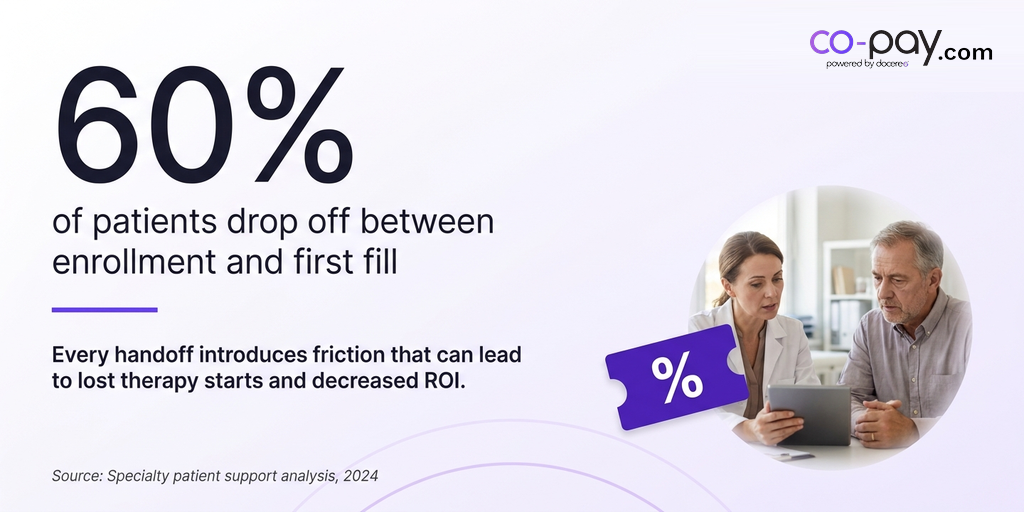
- Greatest loss at enrollment step: This is the steepest filter, with 60% or greater drop-off in some programs (AMA, 2025).
- PA and activation further reduce the cohort: Prior authorization delays and communication gaps after PA approval filter out even more patients before the first fill (AMA, 2025).
- True conversion to therapy start is only a fraction of funnel top: Outreach and “enrolled” numbers may look strong, but real therapy begins only for the minority who survive each handoff.
Stacked together, upstream “wins” compress to 25–35% of therapy starts. The fracture at each transition defines real performance. Counting and closing these gaps is now a competitive benchmark.
Shape D: where co-pay.com fits in the specialty handoff problem
Today’s specialty access landscape is fragmented by design. Hub vendors (Mercalis, Relay) manage enrollment and post-Rx patient services, ePA platforms (CoverMyMeds) run PA separately, and consumer coupon marketplaces (GoodRx) stay outside both the clinical workflow and the patient services loop.
co-pay.com is built to close the workflow gap—the connective layer for manufacturers. Six product functions anchor the solution: co-pay discovery, real-time benefit check at prescribing, ePA before the pharmacy, AI-guided enrollment, activation confirmation, and patient-level analytics, all inside one EHR-native system. With every key step unified, interventions are traceable, handoff loss is surfaced, and program ROI is mapped to confirmed therapy starts.
The Way Forward: making the handoff tax a manufacturer metric
Counting loss at each vendor handoff is now a strategic necessity for specialty brands. The future belongs to those who treat the workflow gap not as invisible leakage but as the metric that shapes their market performance. The leading metric will no longer be enrollment or digital reach, but the number of patients who make it to therapy start across the entire connected workflow. The winners will name the cost of every handoff, build systems to reclaim it, and set the new standard: patient loss at transition points doesn’t just erode ROI—it’s a lever that can be measured and reduced.
Frequently asked questions
What is the handoff tax in specialty drugs?
The handoff tax refers to the cumulative patient loss and expense that occurs each time responsibility for a patient moves from one vendor or system to another within a specialty patient support funnel. Every handoff—discovery to enrollment, enrollment to PA, PA to pharmacy—introduces new points of friction, which result in measurable drop-off rates at each step. The effect is particularly pronounced in specialty therapies due to higher workflow complexity (AMA, 2025).
Why does each handoff lose patients in the specialty access workflow?
Each handoff adds complexity and delay, giving patients and providers additional chances to disengage. Factors include manual data transfer, incomplete or delayed communication, form fatigue, and unclear attribution of responsibilities. With nearly 40 PAs per provider per week and 78–82% of physicians citing patient abandonment related to PA struggles, the risk of loss compounds with every transition (AMA, 2025).
Where do patients fall out of patient support programs most frequently?
Patients primarily fall out at three points: after initial discovery but before completing enrollment, after enrollment but before prior authorization is started (or completed), and after prior authorization but before pharmacy fill. The highest attrition usually happens between discovery and enrollment (60%+ drop-off in some reports), and between enrollment and PA/fill, driven by administrative barriers (AMA, 2025).
How do hub-to-pharmacy handoffs contribute to funnel loss?
When patient support programs hand off from hub vendor to pharmacy, delayed or incomplete data can mean a patient arrives at the pharmacy without PA approval, without activated support, or with inaccurate coverage information. The result is that the support invested upstream is wasted downstream. Nine in ten physicians report negative impact on patient outcomes due to PA and handoff delays (AHA, 2025).
Is it possible to measure patient support handoff loss end-to-end?
Yes, but only with patient-level attribution across the entire connected workflow—a capability that piecemeal vendor stacks rarely deliver. Without a system designed to track every step, losses at vendor handoffs remain hidden or are only estimated post hoc using aggregate data (AHA, 2025).
What is the cost implication of vendor handoff funnel loss?
Beyond lost therapy starts, handoff-driven loss translates to real costs: wasted program spend, increased administrative fees, and lower ROI on patient support investments. U.S. hospitals alone spent $18 billion overturning claims denials in 2025, much of it linked to failures in handoff and information transfer (AHA, 2025).
How does an EHR-native workflow address the specialty access handoff problem?
Bringing all key interventions—discovery, RTBC, ePA, AI-guided enrollment, and activation—inside the prescribing workflow means handoffs between external tools or portals can be nearly eliminated. This deep integration reduces friction. When patients enroll and receive critical support in the EHR context, data lineage and patient journey are aligned, making drop-off points immediately visible and actionable (AMA, 2025).
Why can't analytics tools alone solve handoff loss?
Analytics platforms can highlight where drop-offs occur, but if workflow steps remain fragmented, the handoff risk persists. Only combining the process—operationally and with connected data—enables both measurement and real reduction of patient loss at these junctions (AHA, 2025).
Are there benchmarks on how much patient loss occurs at each handoff?
Industry data shows at least 60% drop-off at the enrollment completion step, and further major losses as patients move through PA and pharmacy activation challenges. Stacking these losses at each handoff yields therapy start rates substantially lower than initial program outreach would suggest (AMA, 2025).
What should manufacturers do to reduce handoff-driven funnel loss?
Manufacturers should move toward a connected, EHR-native workflow that minimizes transitions between external vendors and integrates key access steps. This means tying enrollment, PA submission, RTBC, and activation confirmation directly to prescribing, and ensuring analytics are patient-level and cover the whole process (AMA, 2025). The shift from fragmented offerings to unified workflow is what finally makes the handoff tax both visible and manageable.
Leave a Comment