










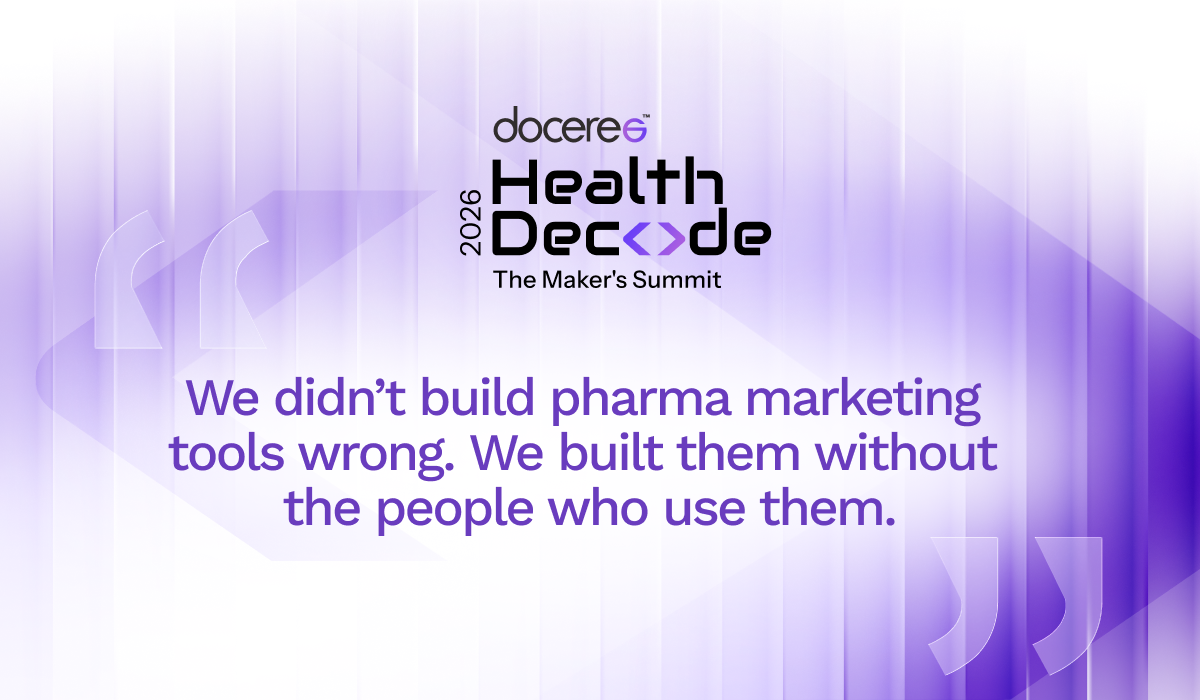
Pharma marketing tools keep getting built without the people who use them. That has to change.
For an industry that prides itself on precision, pharma marketing has an uncomfortable blind spot in how it builds the very tools it depends on.
That blind spot doesn't exist because the industry lacks innovation. It exists because innovation too often happens in isolation. Over the years, I've watched significant investment go into platforms, data systems, and engagement solutions that promise better targeting, better personalization, and better outcomes, only to fall short in the moments that actually matter.
The gap between what these tools promise and how they perform in the real world isn't a technology problem. It's a process problem.
The Disconnect We've Normalized
Most pharma marketing tools follow a familiar path. They are conceptualized in strategy rooms, built against technical and commercial priorities, and validated through internal benchmarks. By the time they reach the people they're meant to serve, HCPs and the marketers deploying them, they are already considered complete.
But "complete" doesn't always mean effective.
When the people closest to the problem are the furthest from the creation process, the result shows up in critical ways. Tools that interrupt clinical workflows instead of fitting into them. Platforms that prioritize features over usability. Campaigns that meet internal metrics but fail to resonate in the moments that matter.
We’ve come to accept this as part of the process. We gather feedback after launch, optimize based on performance, and iterate where needed. But by then, the most important decisions have already been made. The foundation is set, and no amount of iteration fully fixes a flawed foundation.
Why This Model no Longer Works
Healthcare marketing operates in one of the most complex environments of any industry. It sits at the intersection of clinical decision-making, patient outcomes, regulatory considerations, and increasingly constrained time for HCPs. The margin for friction is incredibly small.
At the same time, marketers are under growing pressure to deliver a measurable impact in a landscape that is anything but linear. Expectations around personalization, precision, and relevance continue to rise, while the pathways to achieving them become more fragmented.
In this context, building tools without deeply embedding user perspectives isn't just inefficient; it's ineffective. Because no amount of data or level of technological sophistication can fully compensate for a lack of contextual understanding. If a tool doesn't align with how HCPs think, work, and make decisions, adoption will always be an uphill battle. And if marketers have to work around the system rather than with it, effectiveness will always be limited.
Collaboration as a Category Principle
If we want different outcomes, we need a fundamentally different approach.
Collaboration cannot remain in a late-stage input or a validation step. It has to become the starting point. In today's environment, it is no longer the best practice in healthcare marketing; it is becoming the baseline against which the category will be judged. Building without it isn't just outdated; it limits the very outcomes we're trying to achieve.
This means moving beyond traditional feedback loops and toward genuine co-creation. It means involving marketers, and other ecosystem stakeholders not just as end users, but as active contributors in shaping how solutions are designed from the ground up.
When that happens, the nature of what gets built begins to change. Assumptions are replaced with real-world insight. Complexity gives way to clarity. Usability becomes intrinsic, not an afterthought. Most importantly, the conversation shifts from building tools for industry to building them with industry, and that shift has a direct impact on relevance, adoption, and long-term effectiveness.
The Stakes in an AI-driven Future
This shift becomes even more critical as AI reshapes the pace and scale of healthcare marketing.
We are moving into a phase where AI isn't just supporting decisions; it's influencing the conditions under which those decisions get made. The tools and systems we build today will shape how HCPs are engaged for the next decade. That's a significant amount of influence to hand over to solutions that were designed without the people who will live inside them.
In pharma specifically, the risk isn't just poor adoption. It's that we scale the wrong assumptions faster, at greater cost, with less room to course-correct. AI amplifies whatever is built into it, including the blind spots. Which is why the human context behind clinical and marketing decision-making isn't a soft consideration. It's a design requirement.
Embedding that context from the start is what separates tools that function from tools that genuinely work.
What Comes Next
If collaboration is going to define the future of healthcare marketing, it needs to be moved from principle into practice.
That thinking is what led us to create Health Decode, not as another industry forum, but as a deliberate attempt to change how solutions in this space are built. It is designed as a working environment where the people closest to the problem, marketers, clinicians, and industry stakeholders, are not just participants in the conversation, but contributors to the creation process itself. Where ideas are not only discussed, but shaped, challenged, and refined in real time.
And it doesn't stop at the conversation. What comes out of that room will be tangible—a direct reflection of everything the industry said it needed; finally built the way it should have been from the start.
Because if we believe the future of this category depends on building with the industry, then we have to start creating spaces where that can actually happen.
The industry doesn't need more tools. It needs better ones built with a deeper understanding of the realities they are meant to serve.
And that begins by changing who we build with.
To explore more, visit us at: Doceree Health Decode
Leave a Comment