









A brand-new chapter of Doceree Dialogue begins.
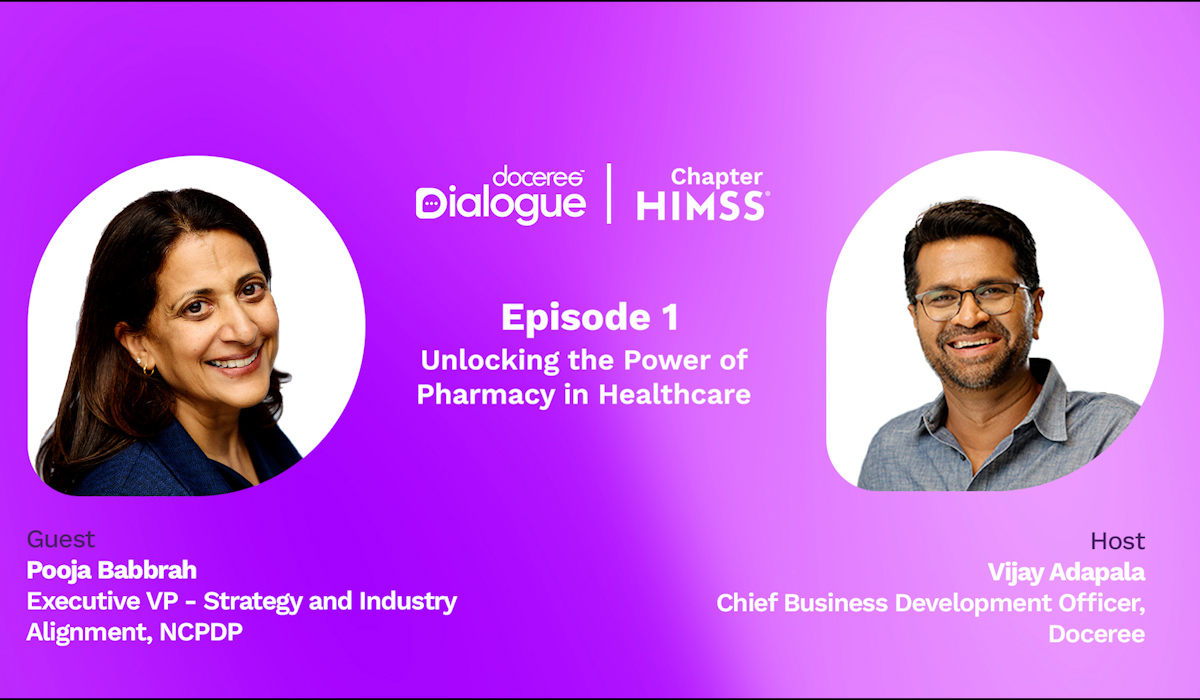
Kicking off Episode 1 of Doceree Dialogue: Chapter HIMSS, we dive into one of the most critical and often overlooked - conversations in healthcare today: the role of pharmacists in building a truly connected ecosystem.
In this opening episode, Vijay Adapala, Chief Business Development Officer, Doceree was joined by Pooja Babra, EVP - Strategy and Industry Alignment, NCPDP, for a powerful discussion on interoperability, innovation, and why the future of healthcare depends on bringing every stakeholder to the table.
 A Career Built Around Access and Workflow
With nearly three decades in healthcare, Pooja’s journey mirrors the industry’s own transformation—from early e-prescribing experiments to today’s digital-first ecosystems.
“My career has been really focused on making it easier for doctors and patients to get information within workflow—whether that's through EHRs, e-prescribing, or now, even on patients’ phones.”
From sending Palm Pilots to physicians in the early days of e-prescribing to shaping interoperability strategies today, her work has consistently centered on one core idea: information should meet healthcare professionals where they are.
 The Missing Link in Interoperability: Pharmacists
While healthcare has made strides in connecting providers and systems, one critical player has often remained underrepresented—pharmacists.
At NCPDP, that’s beginning to change.
“We can’t forget about the pharmacist. They are such an important part of the care team—and they should be at the table when we’re talking about interoperability.”
As pharmacists increasingly take on clinical roles, the need for deeper integration with healthcare data systems is becoming urgent. This means enabling access to patient records, facilitating documentation, and ensuring seamless communication across stakeholders.
From Standards to Real-World Adoption
While standards remain the backbone of interoperability, the focus is now shifting toward adoption and innovation.
“We have our standards—but making sure people are using them is just as important.”
With collaborations across organizations like HL7 and the rise of frameworks like FHIR, the industry is moving toward more unified, data-driven ecosystems.
But true progress lies in bridging gaps—especially within pharmacy systems, which were originally designed for dispensing, not clinical care.
“If pharmacists are going to provide clinical services, they need access to patient data—and the ability to document and share what they’ve done.”
AI in Healthcare: Opportunity, Not Replacement
At HIMSS, AI dominated the conversation and pharmacy is no exception. Yet, the role of AI is being viewed through a practical lens. “We’re not seeing AI do clinical work but it can reduce burden and free up pharmacists to practice at the top of their license.”
From automating routine tasks like medication refills to supporting workflow efficiencies, AI has the potential to unlock time and capacity. However, the human layer remains essential.
“There still needs to be a clinician involved—and pharmacists are clinicians.”
The Road Ahead: Breaking Silos, Building Collaboration
As healthcare moves toward value-based care, the role of pharmacists is poised to expand significantly.
Pooja highlights a powerful real-world example—where provider groups collaborated with local pharmacies to close care gaps, resulting in measurable outcomes and millions in value creation.
“Pharmacists are seeing patients more often than providers. If we connect them with the right data and tools, they can help close critical gaps in care.”
Closing Thought
The future of healthcare won’t be defined by technology alone—but by how well its stakeholders are connected.
And as this conversation makes clear, true interoperability begins when every voice in the care continuum is included.
“In the next five years, we need to make sure we’re not keeping pharmacists in their own silo.”
Because when pharmacists are empowered with data, integrated into workflows, and brought into the conversation—the entire system moves forward, together.
Leave a Comment