










The Pharma Brand Team's Software Problem Is Not About Efficiency. It's About Decision Quality.
The conversation about pharma brand team software has been framed, almost entirely, as a productivity problem. Teams spend too much time switching between systems. Data is duplicated across platforms. Reports take longer than they should. These are real problems, but focusing on them misses the more consequential one. Fragmented infrastructure does not just slow down the pharma brand team. It produces worse decisions.
What Happens to a Decision Passed Through Fourteen Systems
When a VP of Marketing sits down to make a spend allocation decision — which channels to prioritise, which physician segments to weight, how to respond to a competitor's recent launch — they are assembling a picture from multiple sources. Market research from one platform. HCP targeting data from another. Media performance from a third. MLR status from a fourth. Each handoff between systems is an opportunity for context to be lost.
The problem is not that the data is unavailable. In most cases it exists somewhere. The problem is that synthesis across fragmented systems is a manual process that compresses information at every step. The nuance present in the original data gets flattened as it moves through exports, slides, and summaries. By the time a decision is made, it is being made on a compressed version of the information that existed three steps upstream.
The American Psychological Association's research on task-switching is clear that the mental cost of moving between contexts is not just time — it is cognitive capacity. Every context switch depletes the resources available for the decision itself. A brand team spending its analytical energy navigating between systems is spending less of it on the strategic question those systems are supposed to inform.
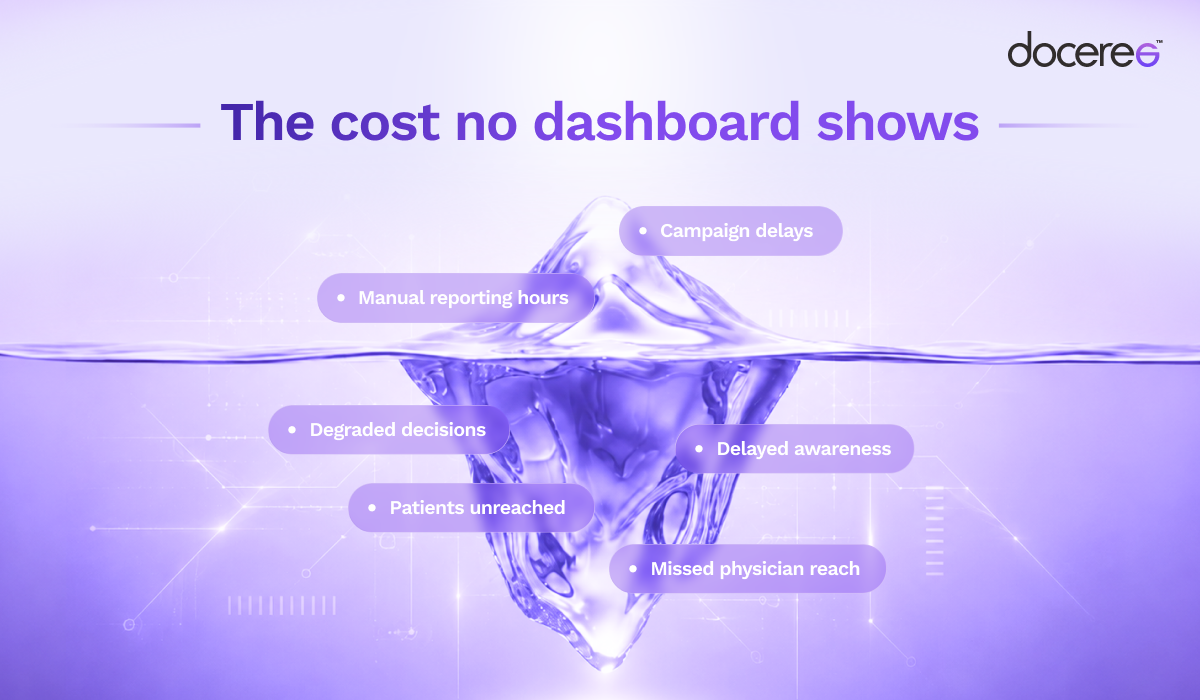
The Cost Nobody Can See in a Dashboard
This is partly why the problem has persisted for two decades. The efficiency cost of fragmented software is visible. You can count the hours spent on manual reporting, the delays in campaign approvals, the time lost in cross-functional alignment. The decision quality cost is invisible. There is no metric that captures how a commercial decision was degraded by the fact that the key insight came from a platform that could not be cross-referenced in real time with the activation data.
What makes this particularly consequential in pharma is the scale of what is at stake. Pharma brand teams are not making decisions that affect next quarter's email open rate. They are making decisions that determine which physicians learn about which therapies, at what time, and in what clinical context. The downstream cost of a poor commercial decision — in missed physician reach, in delayed awareness, in patients who do not receive therapies that could help them — is not comparable to the same decision made in most other industries.
The software environment in which those decisions are made should reflect that reality. For most pharma brand teams, it does not.
Why This Has Not Been Fixed Until Now
The pharmaceutical brand team is genuinely difficult to build software for. The regulatory environment is complex. The data requirements are highly specialised. The workflows cut across brand, agency, and field force in ways that do not map onto general-purpose enterprise platforms.
These are real reasons why this category has not existed until now. They are not good reasons to accept a fragmented stack as a permanent operating condition.
Every other major enterprise function that faced comparable complexity eventually got its own system of work. HR workflows were too consequential to run on spreadsheets, and then Workday existed. Sales operations were too distributed to manage on whiteboards, and then Salesforce existed. The logic that produced those categories applies to pharma brand teams with at least the same force — arguably more, given what is downstream of their decisions.
The Question Worth Asking
The frame worth adopting is not how to make the existing stack more efficient. It is: what quality of commercial decision does this operating environment allow — and is that good enough for the decisions being made?
For most pharma brand teams, the honest answer is no. Not because the people making decisions lack capability. Because the infrastructure they are working in was never designed for the decisions it is being asked to support.
Frequently Asked Questions
What is the pharma brand team software fragmentation problem?
Pharma brand teams typically operate across 9 to 14 separate systems for market research, HCP targeting, media planning, measurement, CRM, and MLR workflow. The cost is not just time lost switching between platforms — it is context lost in transit and decision quality degraded at every manual handoff.
Why does fragmented software affect the quality of commercial decisions?
Each handoff between systems compresses information and loses nuance. Research on cognitive task-switching shows that moving between contexts depletes the mental resources available for judgment. Teams navigating multiple platforms spend less cognitive capacity on the commercial question those platforms are meant to inform.
What is a system of work for pharma brand teams?
A system of work is a single platform where a function plans, decides, executes, and measures without moving data between systems manually. HR has Workday. Sales has Salesforce. Pharma brand teams — running some of the largest marketing P&Ls in any industry — have historically had no equivalent.
Leave a Comment