








.jpg)
The night before Fierce Pharma Week
The night before Fierce Pharma Week 2026, Doceree launched its Intent-Powered HCP Suite with a rooftop event and a 300-drone show over Philadelphia.
On September 14, the team hosted a Rooftop Social at the Assembly Rooftop Lounge at The Logan Hotel. Guests gathered for cocktails, skyline views and conversation before the week’s schedule took over. The room brought together agency leads, publishers and platform teams, along with familiar faces the team had connected with well before the trip.
What makes an evening like this work is who you end up standing next to. The talk ran fast and specific, from where pharma engagement is heading to the distance between what the industry says about omnichannel and what most of it can execute on a Tuesday. Those are the exchanges that never fit into a session slot. Starting the week this way, before the badges and back-to-back meetings take over, tends to surface the ones worth having.
We also used the night to give guests an early look at Daily Command, the decision layer we've been building to run the full campaign lifecycle, from plan through optimize. Enough to open the questions we came to Philadelphia to answer.
The week is officially underway. More conversations, more sessions, and a few more reveals ahead. If we missed each other on the rooftop, we won't for long.
%201%20(1).png?width=1200&height=700&name=leadership%20team-PR%20(9)%201%20(1).png)
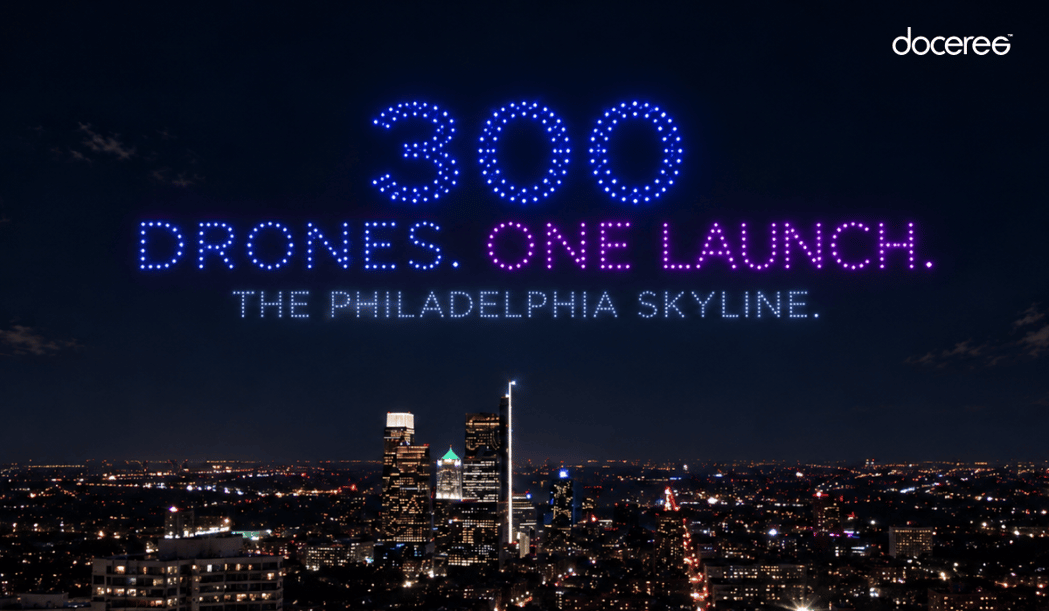
Later in the evening, the conversation on the rooftop stopped. Three hundred drones lifted off the Philadelphia skyline and held it for about ten minutes, and every phone on the rooftop went up at once.
What played out overhead was a single moment, told at the scale of the skyline: every read, every hesitation, every wait that leads up to the instant a prescription is written. The drones drew that moment, then resolved into three words above the city: Clinical Intent Signals.
From there the formation opened out, channel by channel. CTV, Social, Programmatic, Email, DOOH, Point of Care, each one lighting up as part of the same connected system. The finale held one line, three hundred drones tall: Understand every intent. Improve every outcome.
Every formation mapped to something specific: the launch of Intent Powered HCP Suite. CTV, Social, and Programmatic now run on the same real-time clinical orchestration already behind Care Sequence and DOOH. No waiting on claims data that lands weeks late. Each channel moves the moment clinical intent does, live, from the workflow itself.
Most launches get a press release and a quiet Tuesday. This one got the skyline.
We wanted the industry to feel the idea before reading a single spec sheet. On a rooftop in Philadelphia, the night before Fierce Pharma Week, they did. And the week hadn't even started yet.
Day 1: The Conversation the Industry Was Waiting For
Twelve hours after three hundred drones spelled Clinical Intent Signals over the Philadelphia skyline, the badges were on and the sky was still the first thing anyone talked about. Half the conversations at Booth #1001 this morning started the same way, someone asking if you'd seen it, and someone else already pulled up the video to show them. Day 1 had a lot to live up to after a night like that. It did.
-1.jpg?width=2400&height=1400&name=Image%20(1)-1.jpg)
The day itself opened fast. On the Spotlight Stage, Albert Colleluori made the case for One Signal, Every Screen, arguing that pharma has spent a decade adding channels and losing the moment in between them. This is the thinking behind Intent Powered HCP Suite, announced the day before: a single clinical signal formed from the instant a diagnosis is entered; a script is considered, and it activates every screen that matters. DOOH in the waiting room. CTV in the physician's household. The message is already sitting inside the workflow. Not three plans. One signal, moving before intent decays.
Later in the day, the room filled for something we do not usually see on a pharma agenda. Harshit Jain sat down with Maria Menounos for a fireside chat built around one question: what was my doctor thinking? Maria has asked that question twice, once through a brain tumor, once through a pancreatic cancer diagnosis, and she asked it again on stage, directly, to a physician who built a company around the answer. Two sides of the same prescription, in the same room, for the first time either of them had said it out loud in public.
Back at the booth, the line for Daily Command walkthroughs never really thinned out. People wanted to know more about Intent Powered HCP Suite, the offering we had been describing in the sky the night before. A few steps away, our Phone Cover Printing Kiosk turned into its own small attraction; attendees lining up to design and walk away with their own one-of-a-kind cover.
One session made an argument. One made it personal. If Day 1 felt like this, we cannot wait to see what Day 2 brings.
Day 2: Past the demos, into the questions that decide a plan
Doceree’s second day at Fierce Pharma Week 2026 focused on clinical intent and agentic AI. Wednesday’s two sessions examined how pharma buys media across the patient journey and what it takes to manage AI agents in live campaigns, while conversations continued at Booth #1001.
.png?width=2400&height=1400&name=blog_3%20(1).png)
The first was The Room Where It Happens, led by Kamya Elawadhi. She opened with a premise everyone in pharma recognizes: a treatment decision moves through three settings before it's done. The waiting room, where the patient sits with their questions. The exam room, where the script gets written. The pharmacy counter, where it gets filled or left unfilled. Then she put a brand, an agency and a point-of-care network on the same stage and opened the debate. Glenniss Richards of Bayer, Hyun Lee-Miller of Good Apple, and Linda Ruschau of Patient Point went back and forth on the question that actually matters: Can one clinical signal reach all three of those moments, or is the industry still buying them separately because that's how it has always been done? Getting a competitor onto your own stage and holding everyone to the real argument takes more confidence than a pitch ever could. That is the ground Care Sequence is built on and Doceree owned the conversation by hosting it in the open.
In the afternoon, on the Operationalizing Agentic AI panel, Graham Wilkinson raised the issue of accountability: getting an agent to do something impressive on stage is easy. Answering for what it does on its own, across live campaigns, with real budgets and regulatory requirements, is the part that counts. Governance. Guardrails. Knowing in real time what your agents are doing. It was the least flashy stretch of the day and probably the most useful, because it wasn't trying to sell anyone anything.
Back at the booth, the Daily Command demos ran without a break into the evening. Day 1 got people talking. Day 2 got them invested. One more day to go.
Day 3: The drones opened the week, the signal closed it
Doceree has been building on clinical intent for months. This week showed how far it has travelled: three hundred drones over Philadelphia, bringing to life a signal the company has spent years extending across more channels.
The moment that stayed with people was the quietest. Harshit Jain and Maria Menounos sat down for a fireside conversation about what a doctor is thinking in the seconds before a prescription is written. Maria has lived that moment from the patient's side, through a brain tumour and a pancreatic cancer diagnosis, and Harshit has spent years building toward the answer from the doctor’s side. Two perspectives on the same moment, shared on one stage. It set the context before any of the product conversations started.
.jpg?width=2400&height=1400&name=Image%20(4).jpg)
From there, the story was expansion. The HCP Suite carried clinical intent into CTV, social and programmatic, three channels it hadn't reached before, using the same real-time orchestration already live in point of care and DOOH. Kamya Elawadhi took the idea from screens to people, bringing a brand, an agency, and a point-of-care network on stage to discuss whether one signal can reach all three rooms a prescription moves through: the waiting room, the exam room, and the pharmacy counter. And Graham Wilkinson focused on what that expansion demands: how you govern agents once they start acting on their own across live campaigns.
Back at Booth #1001, those conversations continued all week. The demos that drew a crowd early turned into planning conversations by the end, and the questions became more specific as people moved from watching to working through the details.
By the final day, the shape of it was clear. Clinical intent now covers more of the prescription journey than it ever has, from the waiting room to the pharmacy counter, across nearly every screen in between. The drones opened the week. Everything that followed showed how far that signal now reaches.
Leave a Comment